
Specifications
Configuration by Boat Type

This is a listing of some of the boats we have provided a Hydrovane for, showing the configuration used (Shaft Length, Upper Bracket, Lower Bracket). Please note that the same model boat does not necessarily use the same configuration – there are variables such as aerial obstructions and other boat-specific factors.
Overall Dimensions
This schematic may be helpful for you to understand the fit requirements for the Hydrovane. We want to position the Hydrovane tiller at an appropriate height while also ensuring that the Vane has enough airspace. This schematic shows our Standard Vane.
The Drive Unit

Today’s Drive Unit is the VXA1 / VXA2 Model.
The Drive Unit is where the magic happens… it is the sophisticated linkage mechanism that multiplies the forces on the vane by many times.
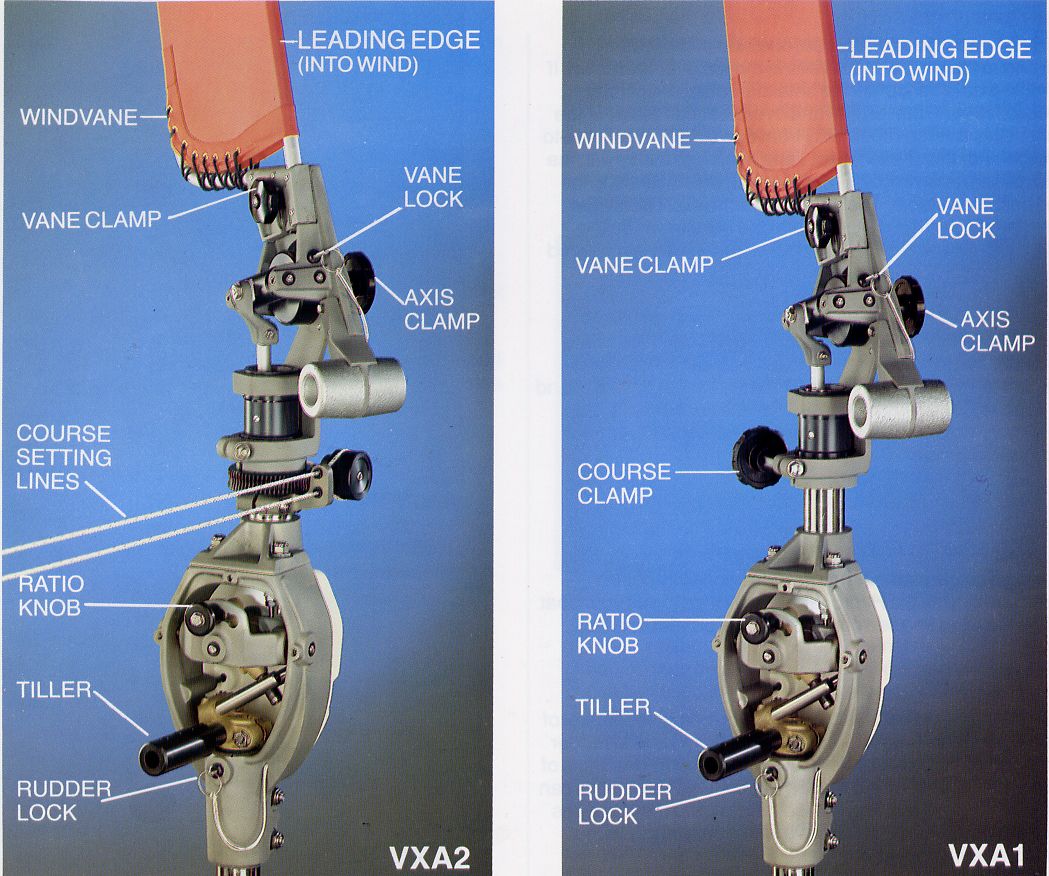
The Drive Unit
Both are variations on the only model available today, and since 1986. The majority of Hydrovanes sold are the VXA2 model; the remote course setting capability is well worth it. A VXA1 may be suitable for a smaller cruising boat with an arm’s reach from the cockpit to the Course Control Knob.
If required for your installation, we now frequently offer variations on the Heading Tube length to raise the Vane’s pivot point.
XTHT12: A 12″ extension of the Heading Tube and Con Rod
XTHT20: A 20″ extension of the Heading Tube and Con Rod
The Vane
The Hydrovane vane needs a lot of airspace .
Potential aerial obstructions we must consider: bimini that reaches aft, an arch/gantry, radar post/mast, wind generator, dinghy davits, etc.
We need photos taken at 90 degrees to the transom and from dead aft – showing from the water to the top of those obstacles – in order to properly configure the Hydrovane for your boat.
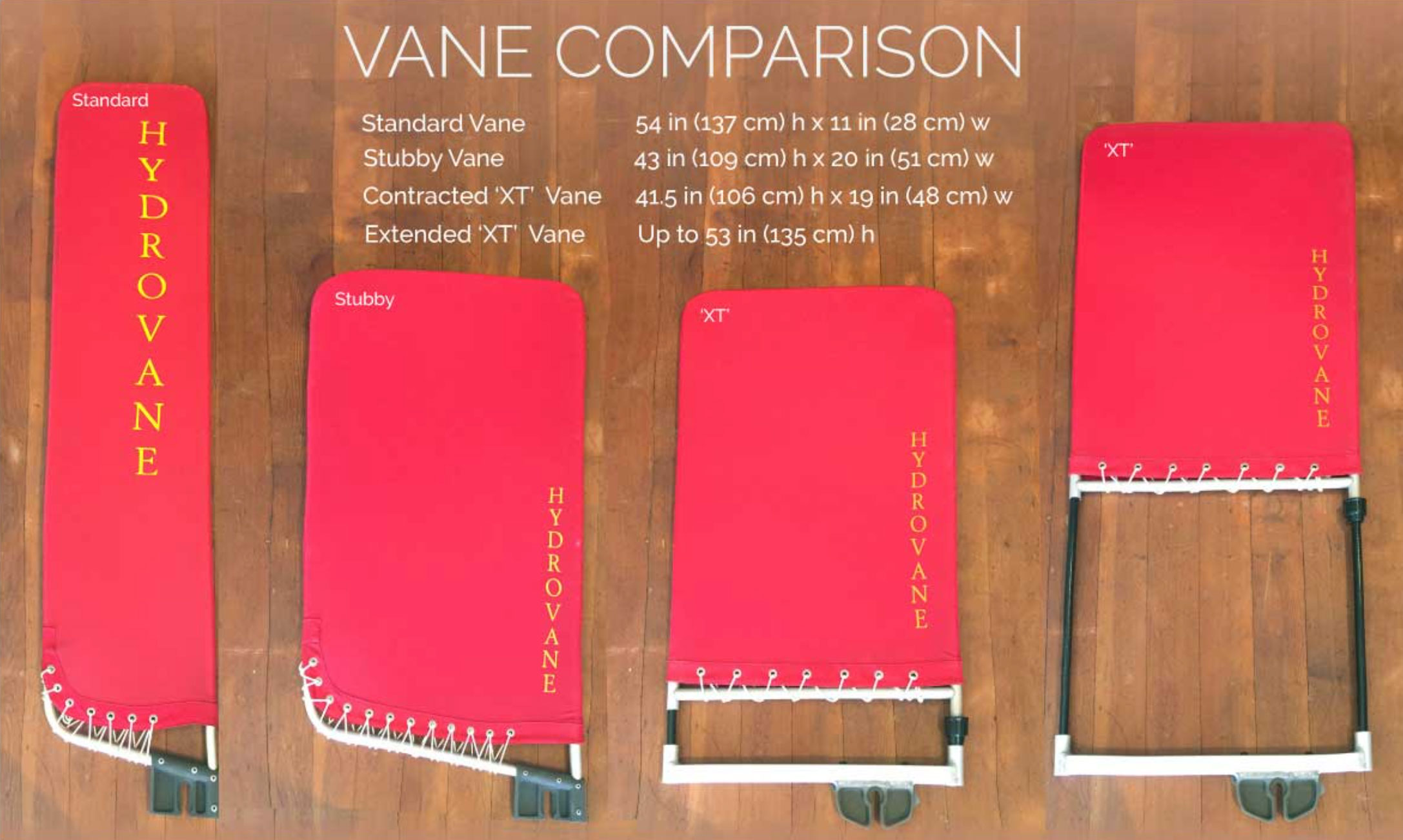
The Vane
A: Standard Vane
54in (137cm) h x 11 in (28cm) w
B: Stubby Vane
43in (109cm) h x 20 in (51cm) w
C: Contracted “XT” Vane
41.5in (106cm) h x 19 in (48cm) w
C: Extended “XT” Vane
Up to 53in (135cm) h
Shaft Assembly
The Hydrovane shaft assembly includes the shaft, the outer tube, and shaft bearings.
Older units: The shaft outer diameter will be either 1 1/8 in (28.575 mm) – out of production since 2002 – or 1 ¼ in (31.75 mm).
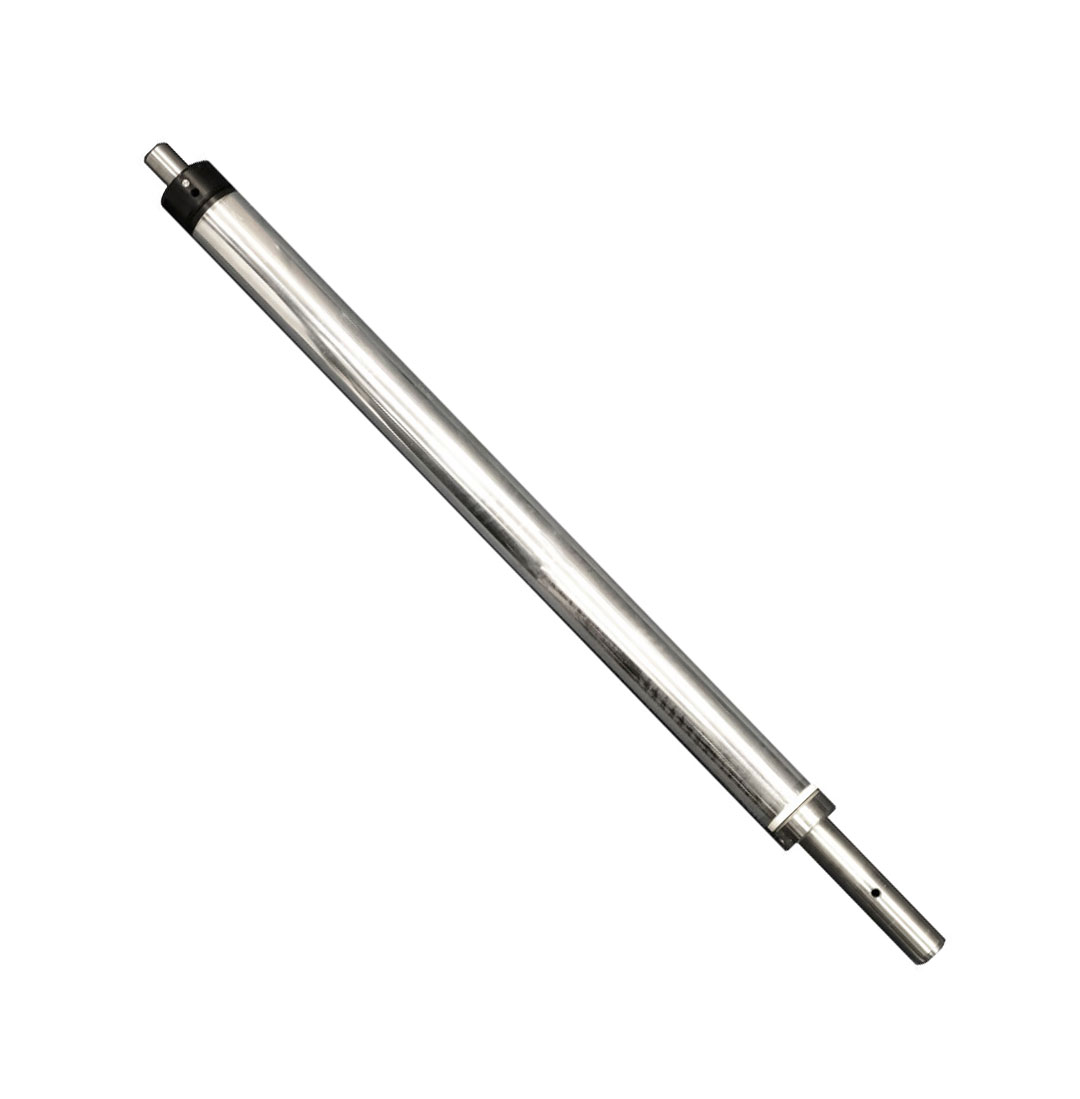
The Shaft Assembly
Since early 2009, all shafts are made of solid 1 ¼ in Ferrinox 225 ‘Super Duplex’ stainless steel – three times as strong as the previously used ‘316’.
All shafts are machined to 1 in (25.4 mm) at the top.
The tube has a 2″ outer diameter.
Shaft Required
The length required depends on the stern height, and if there are any aerial obstructions. The table below shows the required shaft length, assuming that for free vane movement the stern rail is not more than 24 in (610 mm) above the deck and does not project aft of the stern. Otherwise, the next longer shaft may be needed.
Shaft Lengths
These measurements are from tip to tip of the inner shaft. When the Drive Unit is fitted onto the shaft, about 8 inches (203 mm) of the shaft assembly is covered.
*In 2018 we added an extra 3mm to the top of the shaft (the part that is machined to 1″ OD). Below are the original tip to tip measurements.
The Brackets
Every installation requires two brackets – a combination of the three brackets we manufacture. The brackets required are entirely dependent on the transom of your boat.
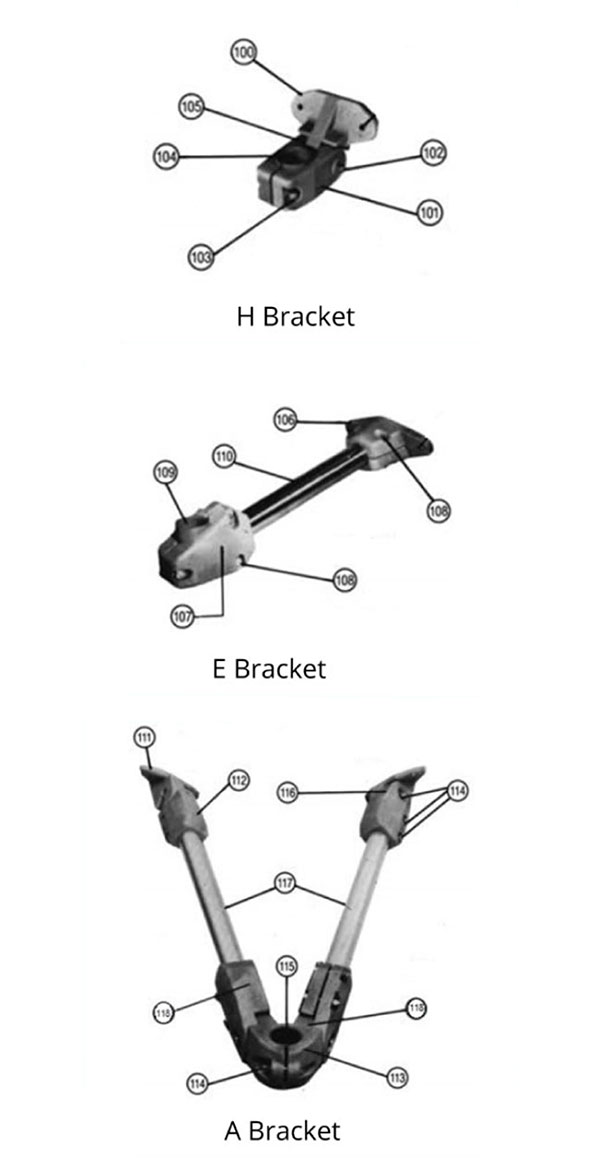
The Brackets
H ‘Hinged’ Bracket
Every installation must have at least one H Bracket. The ‘H’ bracket is located at about the closest point from the shaft to the stern.
E ‘Elbow’ Bracket
This is the single strut bracket. It can be more difficult to install, but is less expensive than the A bracket.
- It is the only bracket without a hinge, meaning the angles are fixed and must be accommodated by using timber pad(s) to accommodate the contour of the hull and the difference in angles.
- Fixed Angles – Each of the castings at either end of the Strut (Stay Tube) hold the tube at an angle of 15 degrees. The result, depending on the direction the castings are positioned, creates aggregate angles of either 30 (15 + 15) or zero (15 – 15) degrees.
- The Strut is provided at a maximum length of 18”, to be cut down to required length.
A ‘Double Strut’ Bracket
The A bracket is our biggest, strongest, and most versatile bracket. The A bracket solves the most difficult installation issues.
- Arms swing up or down vertically
- Arms open in or out from 40 to 80 degree separation (as of summer 2013 – prior model fixed at 40 degrees)
- Transom attachment flanges fully rotate to become flush with any surface.
- Strength – Engineers love triangles
- Struts/tubes can be cut to any length. Struts are provided at 31”, to be cut down as necessary. Some installations require even longer tubes, which we can provide.
Mounting Pads
A Mounting Pad is a shaped piece of non-ferrous material (often teak wood or a synthetic like G10 Micarta or High Density Polyethylene – HDPE – is used) that is fitted between the bracket flanges and the transom. The Mounting Pad is fashioned or shaped to pick up any contour differences between the flat flange face and the transom.

Mounting Pads
It is common that a Mounting Pad must be made and shaped to pick a contour or angular difference between a flat bracket flange and the transom.
We offer: Mounting Pads made of Teak (T) or Plastic (P). H Spacer pads – if needed – do not have the finished edges.
A: H Mounting Pad
Part #100T or #100P
Spacers – Part #100TS or #100PS
#100T – 3/4” thick, #100P – 20mm thick
#100TS – 1.1” thick, #100PS – 30mm thick
B: E Mounting Pad
Part #106T or #106P
#106T – 1.1” thick, #106P – 25mm thick
C: A Mounting Pad
Part #111T or #111P
#111P priced as a pair
#111T – 3/4” thick, #111P – 20mm thick
The Rudder
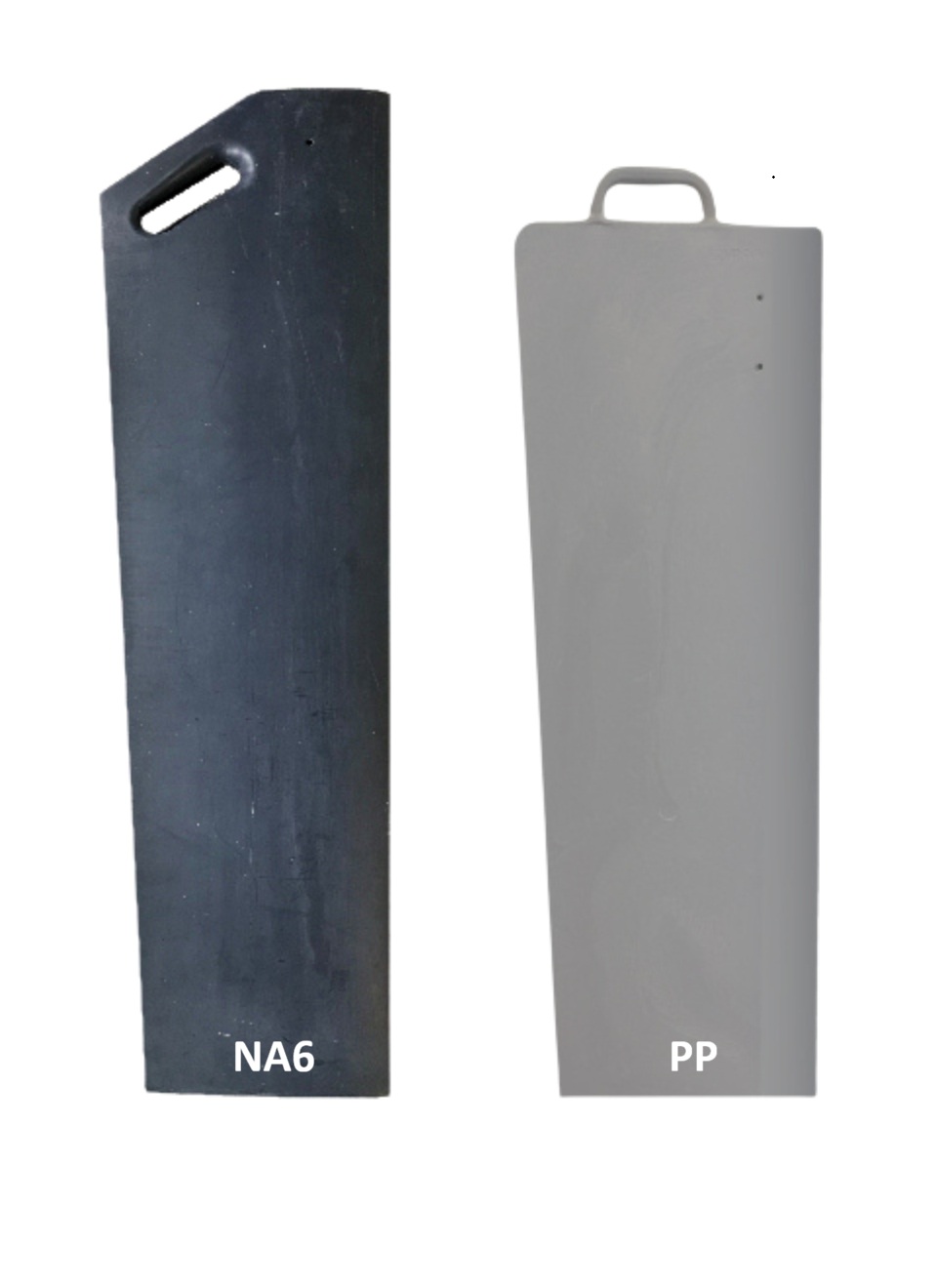
Nylon (PA6) Rudder
This is our mainstay Rudder. It is suitable for all boats. The nylon Rudder has been developed over the past two decades. The current version is 43″ long with a NACA profile.
Due to its power, it must be supported by the Super Duplex stainless steel Shaft (2009 or newer). 316 stainless steel is not strong enough.
Polypropylene (PP) Rudder
Due to the escalting costs of nylon, we offer a shorter (37″) polypropylene Rudder to boat up to 37ft.
This Rudder does not have the same power or strength, but it a cost-effective solution for smaller boats.
Orca Rudder
The Polypropylene (PP) Rudder is the preferred Rudder to use in the Orca Zone, for all boats. Past interactions show that should the orcas “play” with the Polyproylene Rudder, they tend to break it off without damage to the Hydrovane Shaft.
We offer this Rudder at 50% as a second Orca Rudder for those transiting the zone.
More Information
Helpful Measurements
- H bracket creates a distance from shaft to transom of between 1.5 in (3.8 cm) to 4.5 in (11 cm)
- The minimum distance required for an E bracket is 8in (20 cm)
- The minimum distance required for an A bracket is 16in (40 cm)
- The maximum exposed shaft between the top bracket and the drive unit is 18 in (46 cm)
- Space, distance between the bottom bracket and the bottom bearing: between 2 in and 10 in (5 cm and 25 cm)
- The minimum separation between the two rudders should be 8in (20 cm)
- Weight – In water weight varies based on configuration:
- Lighter – 66 lbs (30 kg) – S/H/H
- Average – 83 lbs (37 kg) – L/E/H
- Heavier – 113 lbs (51 kg) – X/A/H
Materials
- Shafts, axles and fastenings: 316 (EN58J) stainless steel except the main shaft which is Ferrinox 255 (Super Duplex), solid stainless
- Castings: LM25 anodized aluminum alloy and silicon bronze
- Bearings: Glass Filled PET, PFTE and Acetal (Delrin). Nylon ball race on rudder shaft.
- Rudder: Solid N6 nylon casting. Tapered NACA profile
- Wind Vane: Reinforced nylon cloth (ripstop) on anodized alloy tube frame
Course control: 4 in (100 mm) oilon worm gear