
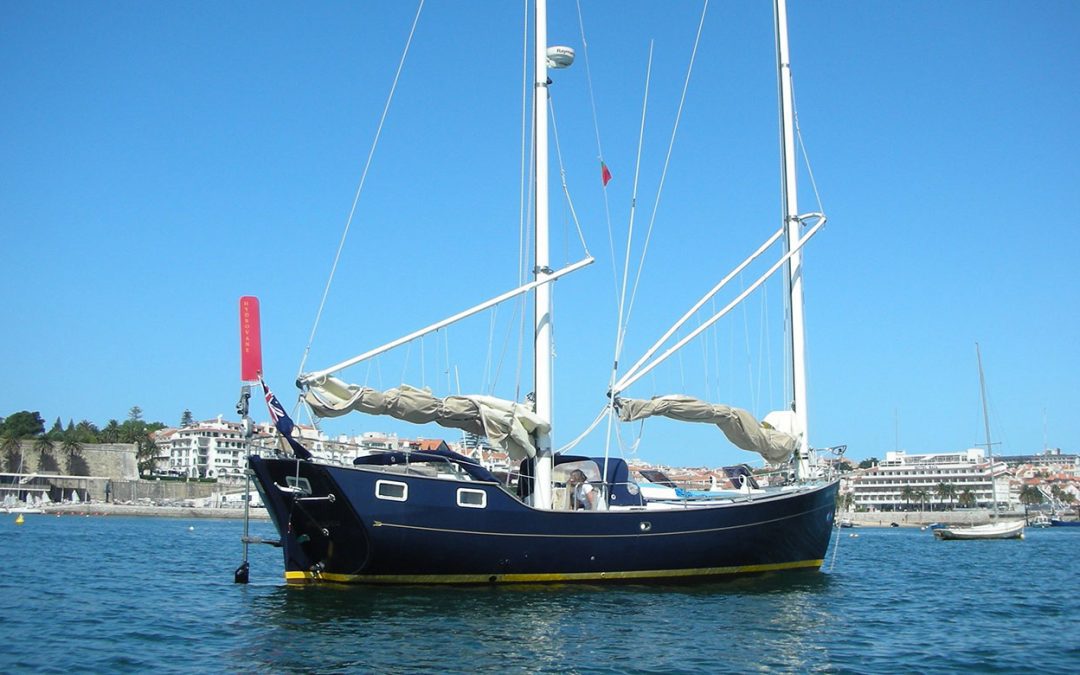
To begin with, the Hydrovane rudder is not small. People who get to see it are often surprised at the size. Today’s rudder has a surface area of nearly 3.5 sq ft, or 1/3 of a sq m. It provides plenty of steering power, especially because of its leveraged position so far aft.
What is important to note is that the main rudder is locked – not on the center line but in the sweet spot that compensates for any weather helm – making for a perfectly balanced boat when ‘on course’. The main rudder, although fixed, is very significant in its steering contribution:
- Acts as a giant ‘trim tab’ – compensates for weather helm
- Provides directional stability
- Boat biased to hold course and will know exactly when it is back on course
- Improves boat motion
- Makes the Hydrovane’s job much easier – its rudder only kicks into gear once the boat heads off course, and the Hydrovane semi-balanced rudder is very nimble, with near immediate response
The simple answer to the question is that “two rudders are better than one”.
When comparing to other types of windvanes that steer using the boat’s main rudder, there are some misconceptions.
For example, some may initially think that using the boat’s main rudder to steer (such as with a servo pendulum windvane), would provide more steerage. However, those units only pull a line by about 10 in (25 cm), which is about enough to move the ships wheel a half a turn in each direction (typical wheels have 3 revolutions, stop to stop). That is all that is needed – not much, and certainly not the rudder’s full potential.
The fact is, large boat rudders are needed only for maneuvering at low speeds, especially in marinas. With incremental boat speed less, less rudder size is needed. Notice the America’s Cup helmsman doing only the slightest movement of their wheels.
The Hydrovane rudder has been improved on over the years. We are now steering much heavier boats thanks to these changes:
- 1986: change from fiberglass on foam to solid cast nylon… virtually indestructible!
- 2006: length increased by 5.5 in /14 cm
- 2009: thickened by adding 5 lbs /2.3 kg – now weighs 23 lbs /10.5 kgs (half in water)
- Summer 2009: version developed by our in-house engineer, Ted Hargreaves. Ted inspired the upgrade based on his aeronautical experience with foils. After the first test Ted reported it was much more powerful but so light to the touch – easy to control – couldn’t believe that it could be that good while also being so very stable. It is a vast improvement. We strongly recommend the upgrade for any owners with older versions of the rudder who would like the extra power.
- 2022: Our newest rudder offers more surface area and lower drag than any of our previous models
Recent Comments